
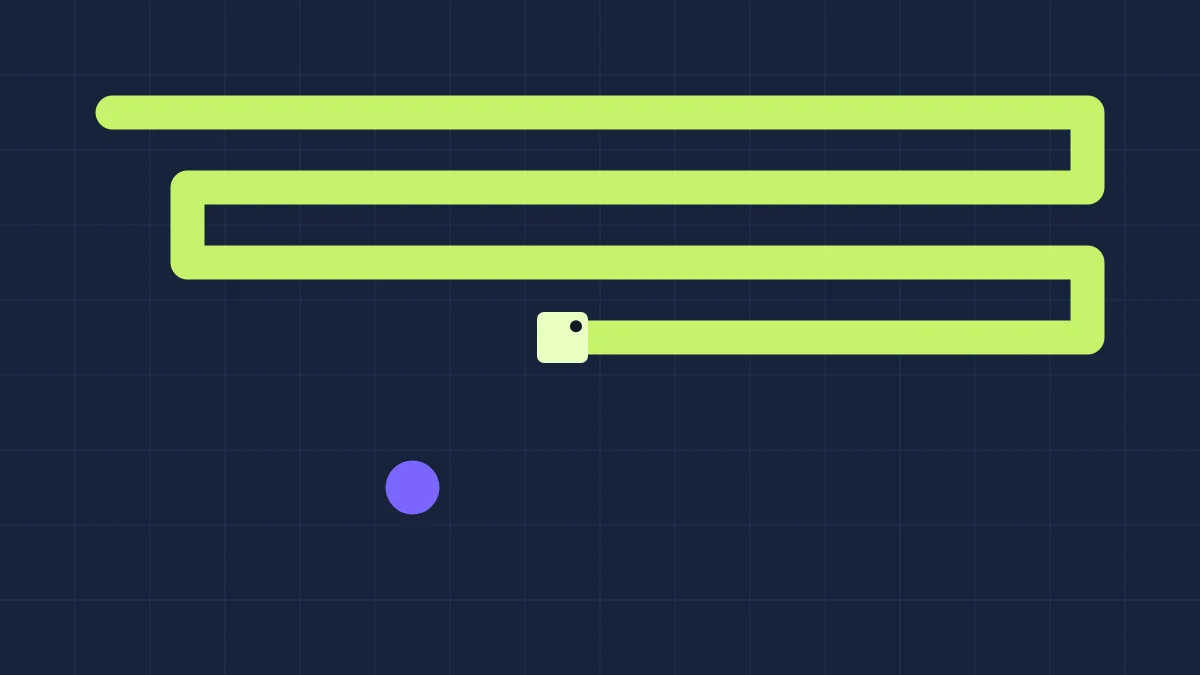
Quick answer
To beat Snake, stop chasing food in a straight line once your snake is long. Move in a repeating pattern that covers the board — a zigzag with a return lane — so your body never boxes you in. Take shortcuts only while the snake is short, never enter a space smaller than your snake, and play on a slower speed until the pattern feels automatic.
“Beating” Snake can mean two things: setting a new high score, or filling the entire board so there’s no room left. The same strategy gets you both. It’s built on one idea — protect the space your snake will need later — and it works in classic Snake and in Google Snake’s standard modes.
The one idea behind every good Snake strategy
Early on, your snake is short and the board is mostly empty, so almost any move is safe. The danger grows with your length. Every time you eat, you add a segment that won’t move out of the way for a while, and the space around your head shrinks.
Your tail is your friend here. Each time the snake moves without eating, the tail moves too and frees up one tile. As long as your head can always reach open space — or follow the tail — you can’t get trapped. Runs end when the head enters an area that has fewer free tiles than the moves it needs before the body opens a way out.
A 7-step strategy for beating Snake
Slow down your decisions
Most crashes come from rushed turns, not slow reflexes. Practice on a slower speed until you can say where your head is going two or three moves ahead.
Use the edges early — not late
While the snake is short, running along a wall keeps your body out of the middle of the board. Once the snake is long, circling the whole edge can wall off the center, so switch to a pattern.
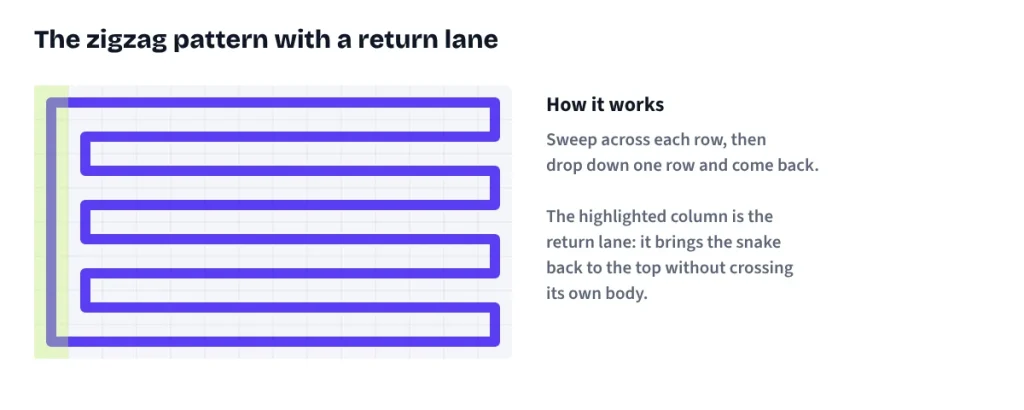
Move in a zigzag pattern
Sweep across the board row by row (or column by column), dropping down one line at each end. Your body stays in neat, parallel lanes instead of a tangle, so you always know where the free space is.
Keep a return lane
Leave one edge row or column free as a lane back to the start of your zigzag. That turns the pattern into a loop you can repeat forever, which is what keeps very long snakes alive.
Take shortcuts only while you’re short
Cutting straight to the food saves time, but every shortcut breaks your pattern. It’s safe when your snake is short compared to the board. As you grow, take only shortcuts that rejoin the loop ahead of your tail.
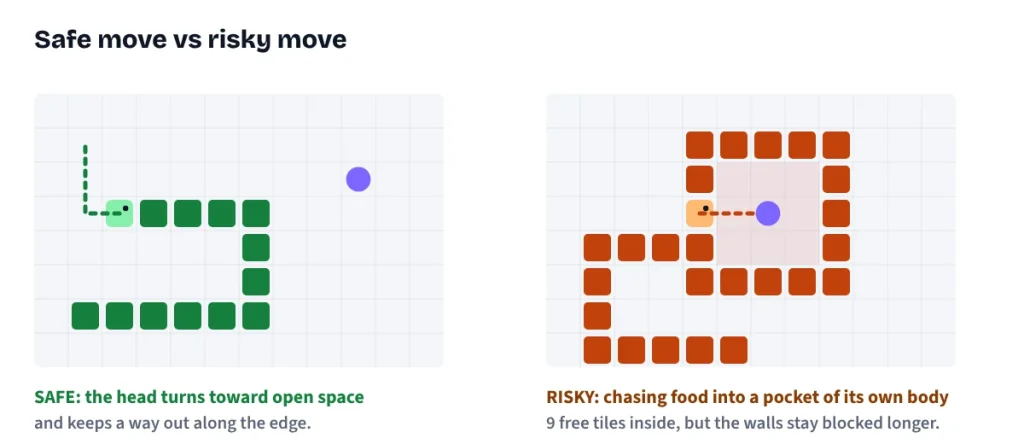
Never enter a space smaller than your snake
Before turning into a pocket, ask: how many free tiles are in there, and how many moves until my body leaves the walls? If the space is smaller, the food isn’t worth it — wait for the next one.
Plan the endgame
Near a full board, free tiles are scattered and food appears in awkward places. Stay on your loop, move one tile at a time and follow your tail. Patience wins the last few points.
Pro tip
When food appears behind your snake, don’t U-turn through your own lanes to reach it. Keep following the loop — it will bring you to the food safely, even if it takes longer.
Common mistake
The mistake: making a beeline for every piece of food, which leaves the body scattered across the middle of the board. The fix: from about the moment your snake stops fitting comfortably along one wall, commit to your pattern and let the food come to you.
Safe loop vs. greedy shortcuts
Strategy breakdown
Which approach should you use?
Strong players mix both. The loop protects you; shortcuts save time. The skill is knowing when each one fits.
| Greedy shortcuts | Safe loop (zigzag) | |
|---|---|---|
| Best when | The snake is short and the board is open | The snake is long or the board is filling up |
| Strength | Fast — more points per minute | You can’t trap yourself if you follow it |
| Main risk | Body ends up scattered; easy to box yourself in | Slow; food behind you takes a full lap |
Common ways runs end — and how to avoid them
- Turning twice by accident. Press each direction once, at the moment you want to turn.
- Following food into a dead end. Check the space before you enter it, not after.
- Wrapping the whole board. Circling the edges with a long snake seals off the middle. Use lanes instead.
- Losing track of the tail. Your tail shows where space will open next. Glance at it before every risky turn.
Version note
Some Google Snake modes change the problem. Modes that add walls or other obstacles can block your pattern, and the speedrun community treats Wall and Portal modes as modes that can’t be completed — they’re played for high scores instead. The strategy above is designed for Classic-style rules.
How to practice
Pick one setup and stick with it for a while, so your improvement is easy to see. In Google Snake, Classic mode on Slow with a single apple is a good place to start. Once you can follow a zigzag without thinking, raise the speed. If you’re playing on Google’s standard board, our normal map strategy shows a complete loop drawn to fit it.
Key takeaways
- Your goal is to protect space, not to reach food quickly.
- A zigzag with a return lane turns the board into a safe, repeatable loop.
- Shortcuts are fine while the snake is short; stick to the loop as it grows.
- Never enter an area with fewer free tiles than your body needs to clear.
Frequently asked questions
Is it possible to beat Snake?
Yes, in versions with a fixed board. Filling every tile is the ultimate finish, and following a full-board loop makes it possible, though it takes patience. Most players “beat” Snake by setting a new personal best.
What is the best strategy for Snake?
A zigzag pattern with a return lane, combined with careful shortcuts while the snake is short. It keeps your body organized so you always know where you can move.
Does speed affect how hard Snake is?
Yes. Faster speeds give you less time to plan each turn. Speed doesn’t change the board or the strategy, so learn the pattern slowly and then speed up.
Why do I always crash into myself?
Usually because the body ends up spread across the middle of the board. Moving in lanes keeps it out of your way. See our Snake rules guide if you’re still learning the basics.
Curious how far the best players have taken this? Read about the Snake game world record and the highest possible score.
